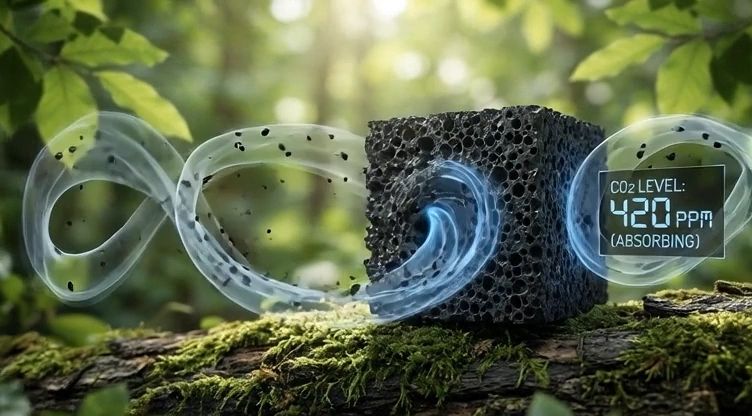
Nextearth ReCarbon™
Nextearth ReCarbon™
The climate crisis is not only an emissions problem; it is fundamentally a design problem. For decades, carbon has been treated as waste — measured, traded, offset, and buried. Global strategies have focused on reducing atmospheric concentration, yet the structural logic of our material systems remains largely unchanged. While innovative carbon storage solutions are emerging, including ReCarbon technology and smart city carbon solutions, carbon is counted but not redesigned.
Developed by Krit Sangvichien, Founder of Nextearth, the rCO₂ Framework repositions carbon from an atmospheric liability to a structural resource. This innovative approach defines a materials-based integration protocol that utilizes ReCarbon technology to transform emitted carbon into stable, engineered components of urban infrastructure, contributing to smart city carbon solutions and advancing effective carbon storage solutions.
Nextearth Mission
Check out this video to learn more about innovative carbon storage solutions, including ReCarbon technology and its role in smart city carbon solutions!
The framework establishes a systemic pathway for implementing carbon storage solutions by redirecting carbon flows from emission streams. It focuses on stabilizing and conditioning carbon into durable forms, which is essential for developing innovative ReCarbon technology. Additionally, the formulation of carbon-based composite materials allows for their integration into infrastructure-scale applications, contributing to smart city carbon solutions. Ultimately, these efforts aim at achieving long-duration carbon permanence within the built environment.
Agricultural residues (coconut shell, rice husk, cassava rhizome, corn waste, etc.)
Low-oxygen, high-efficiency conversion into stable bio-carbon

Pore tuning, surface chemistry control, granulation, and composite bonding
NEBC embedded into concrete, asphalt, water systems, textiles, and energy stacks
Long-term sequestration with measurable carbon sink performance


A family of high-performance bio-carbon materials — not just a commodity, but a functional carbon platform that supports smart city carbon solutions.
Product forms:
• NEBC Powder – additives, coatings, composites
• NEBC Granular – water treatment, PFAS capture, filtration
• NEBC Bio-Cement Additive – carbon-negative concrete utilizing ReCarbon technology
• NEBC Asphalt / Road Modifier – durable, carbon-storing roads that enhance carbon storage solutions
• NEBC Textile Coating – zero-emission functional fabrics
The world is shifting from carbon reduction to carbon removal + storage.
Governments, cities, and industries need:
• Permanent carbon sinks
• PFAS-free water systems
• Low-carbon infrastructure
• Local, secure material supply chains
Nextearth turns climate mandates into physical assets.
Carbon removal and storage solutions are projected to exceed $1 trillion by 2035, showcasing the importance of effective carbon storage solutions.
• Low-carbon concrete and infrastructure are estimated at over $600 billion.
• Water treatment and PFAS remediation are valued at more than $300 billion.
• Sustainable materials and composites are expected to reach $500 billion.
• Smart city infrastructure, which includes innovative smart city carbon solutions, is anticipated to surpass $2 trillion.
Nextearth operates across diverse markets, utilizing ReCarbon technology rather than confining itself to a single silo.
• Plasma-assisted bio-carbon conversion for advanced carbon storage solutions
• Engineered pore carbon structures utilizing ReCarbon technology
• Biomass-derived graphene-like materials as innovative smart city carbon solutions
• Carbon–mineral binding for permanent lock-in in carbon storage applications
• Granular carbon for PFAS adsorption, enhancing carbon storage solutions
• Carbon-embedded infrastructure systems supporting smart city carbon solutions
• Carbon sink measurement & verification frameworks aligned with ReCarbon technology
1. Carbon-Negative Roads
Urban asphalt enhanced with ReCarbon technology to store carbon for decades while improving durability, serving as one of the innovative carbon storage solutions.
2. Bio-Cement for Smart Cities
Concrete additives that reduce cement emissions and convert buildings into carbon sinks, contributing to smart city carbon solutions.
3. PFAS-Free Water Systems
NEBC granular carbon for municipal and industrial water purification, supporting sustainable practices in urban environments.
Smart cities are increasingly focusing on climate infrastructure and innovative PPP projects that incorporate smart city carbon solutions. One promising avenue is the use of carbon storage solutions, such as ReCarbon technology, which can significantly enhance the sustainability of urban environments.
Cement, construction, and textile industries are evolving with innovative carbon storage solutions, such as ReCarbon technology. These advancements are essential for smart city carbon solutions, particularly in sectors like water and energy.
The interplay of climate, deep tech, and infrastructure is crucial in developing effective carbon storage solutions. Innovations like ReCarbon technology are paving the way for smarter approaches, particularly in urban environments where smart city carbon solutions can significantly reduce emissions.
Carbon science plays a vital role in the development of materials engineering, particularly in the context of carbon storage solutions. The integration of ReCarbon technology is essential for advancing smart city carbon solutions, ensuring effective verification of these innovative approaches.
Urban infrastructure and utilities are increasingly focusing on carbon storage solutions to enhance sustainability. The integration of ReCarbon technology in data centers is a key component of smart city carbon solutions, aimed at reducing emissions and promoting eco-friendly practices.
Nextearth transforms biomass waste into innovative carbon storage solutions, utilizing ReCarbon technology to create carbon-locking infrastructure for the smart cities of tomorrow.
Nextearth turns biomass waste into carbon-locking infrastructure for the cities of tomorrow.
There is strong scientific evidence that building materials influence stress levels, sleep quality, and mental stability through environmental mechanisms air quality, acoustics, thermal stability, vibration.
Carbon-Locked Structural Materials & Infrastructure Platform
Authorship & Origination: Introduced and developed by Krit Sangvichien
ReCarbon™ is the execution platform of Recarbonization — translating carbon-locking materials into real infrastructure.
Recarbonization Paradigm are introduced and system-designed by Krit Sangvichien under Nextearth.
This publication serves as a formal documentation of conceptual origin and structural methodology.
The rCO₂ Framework is defined as a materials-based carbon integration protocol that transforms emitted carbon into permanent structural components within urban infrastructure systems.
We love our customers and are excited to share our innovative carbon storage solutions with you, including insights on ReCarbon technology and smart city carbon solutions. Feel free to visit us during normal business hours.
305/2 Sukhothai Rd, Khwaeng Dusit, Khet Dusit, Krung Thep Maha Nakhon 10300, Thailand
Today | By Appointment |
Closed majors holidays.
Get 10% off your first purchase when you sign up for our newsletter!
We use cookies to analyze website traffic and optimize your website experience. By accepting our use of cookies, your data will be aggregated with all other user data.